How to Organize Student Drop-off and Pickup: A Practical Guide for Private Schools
· 8 min read
Drop-off and pickup are the moments of greatest operational pressure at a school — and the ones that most shape how families perceive the quality of school management. A disorganized morning delays the start of classes. A chaotic dismissal creates car lines, stressed families and, in more serious cases, safety incidents that can result in legal liability for the institution.
This guide gathers the best practices for organizing the flow of students at drop-off and pickup — from simple strategies that can be implemented without technology to digital solutions that turn the school gate into a predictable, safe and efficient process.
Why Organizing Drop-off and Pickup Is a Strategic Decision
It's common for administrators to treat student drop-off and pickup as a second-tier operational issue — something for the front-gate staff to handle. The reality is different: these are the moments when the school is most exposed to family judgment, legal risk and operational inefficiency.
Impact on NPS and re-enrollment
Satisfaction surveys from private schools consistently show that pickup line congestion and gate organization rank among the top three topics families bring up. A school that doesn't handle these moments well ends up with families who are pedagogically satisfied but operationally frustrated — creating a real risk of non-renewal even when there is no academic problem.
Legal impact
In most legal systems, schools are held strictly liable for harm that occurs while students are under their custody — including incidents during dismissal. A disorganized pickup, with no documented protocol, is a real legal vulnerability. The burden of proving that proper processes were in place falls on the school.
Impact on the team
Front-gate staff who manage the dismissal of hundreds of students without a defined process work under constant pressure, make more mistakes and have higher turnover. A well-organized pickup reduces operational stress and improves the performance of the entire gate team.
Relevant data: a school with 200+ students without a pickup management system has on average 35 minutes of peak congestion at the end of the day. With digital flow management, that drops to under 15 minutes — a 60% reduction.
7 Strategies to Organize Student Drop-off and Pickup
1. Staggered Dismissal by Grade or Segment
The simplest and most immediately effective strategy. Instead of releasing all students at once, the school distributes dismissal in 10–15 minute windows by grade or segment. Early childhood at 5:00pm, elementary at 5:10pm, middle school at 5:20pm. Large schools often combine this with separate gates for different segments.
Staggering also has a pedagogical benefit: younger children are protected from the flow of older students, and each group gets the appropriate attention during the transition.
2. Digital Family Check-in
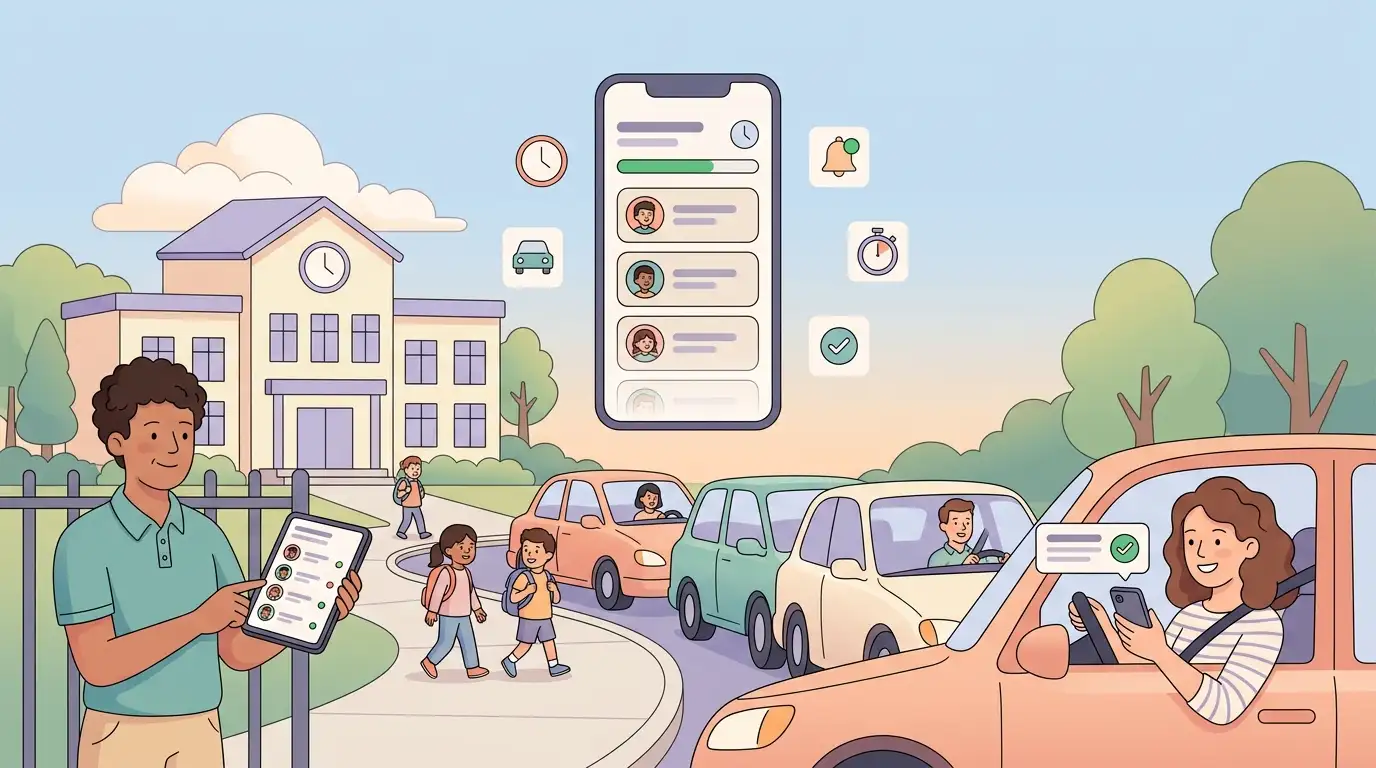
When the family signals through the app that they're leaving home, the school receives the notification and starts preparing the child in advance. By the time the car arrives, the child is already at the gate — eliminating idle time at the curb. This single change reduces pickup time by up to 60% in schools with more than 150 students.
Kidsflow offers exactly this feature integrated with authorization control: the family checks in via the app, the school sees the queue in real time, and children are called in arrival order.
3. Pickup Authorization Protocol
The most critical and most neglected step. The school needs to maintain, for each student, an up-to-date roster of who is authorized to pick them up — with a photo, not just a name. For one-off situations (a grandmother who's only coming today, an occasional driver), there must be a formal authorization channel that reaches the gate before the authorized person arrives and that includes verifiable identification.
WhatsApp is not a formal authorization channel. A message has no verified photo, no auditable trail and no legal validity in case of dispute. The solution is a digital authorization system with temporary QR codes — exactly what Kidsflow offers.
4. Internal Display Board for Early Calling
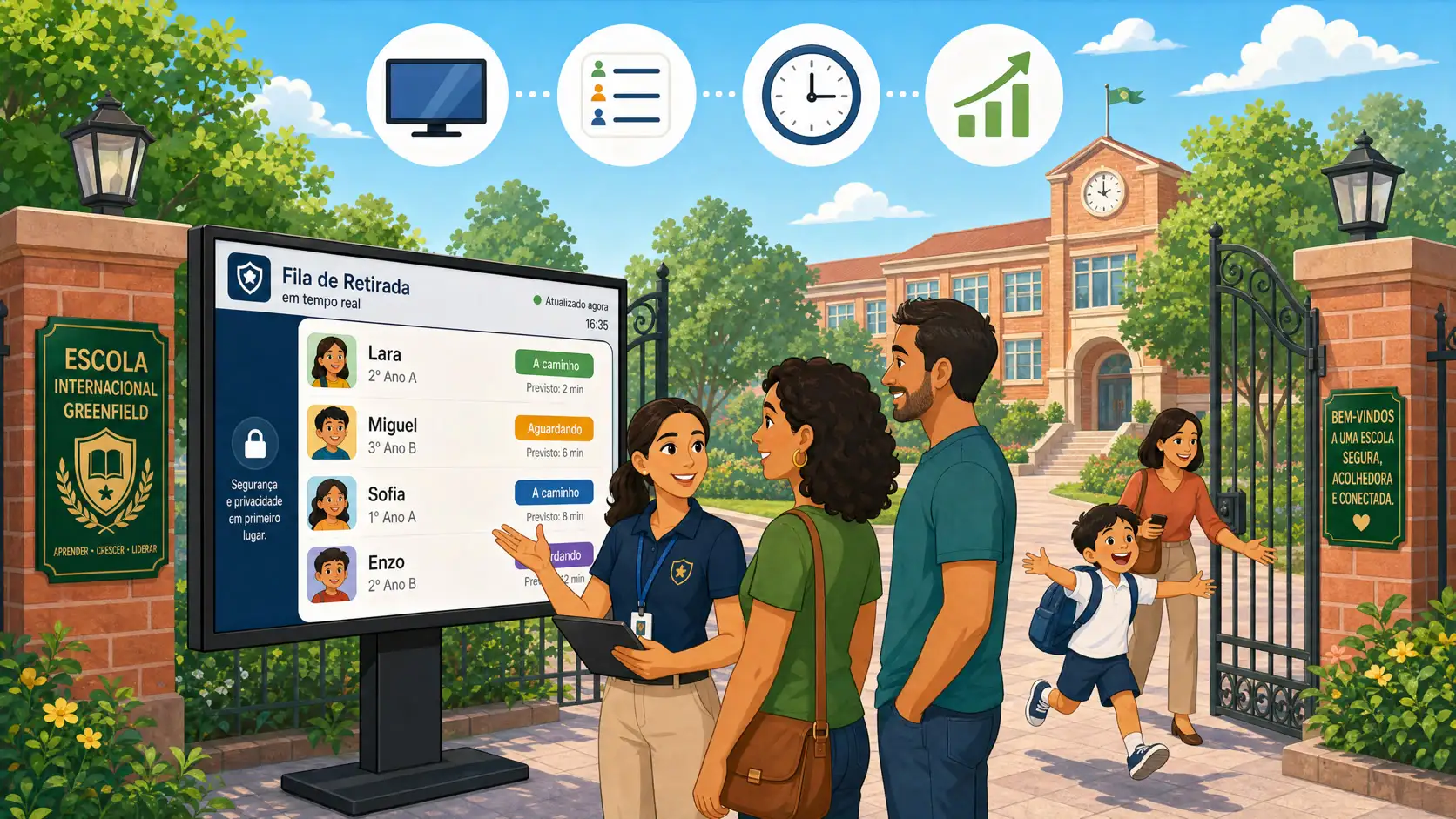
A real-time board inside the school shows who is arriving and the digital queue order. Internal staff call children in advance based on the predicted arrival of their guardian. This process eliminates the main bottleneck of dismissal: the child still in the classroom when the car has already arrived.
5. Clear Rules for Vehicles and Pedestrians
The school must have documented and communicated rules for parents and school transport providers: where to stop, for how long, how to identify the vehicle, what to do in case of delay. These rules should be communicated at the start of the school year, reinforced during the first weeks, and made available in writing in the school's app or portal.
6. Waiting Space for Students Who Arrive Early or Stay Late
Students who arrive before the start time or who wait for guardians after dismissal need an organized space with supervision. This reduces unnecessary circulation at the gate, decreases the risk of incidents and prevents students from being on the sidewalk unsupervised.
7. Push Notifications for Guardians
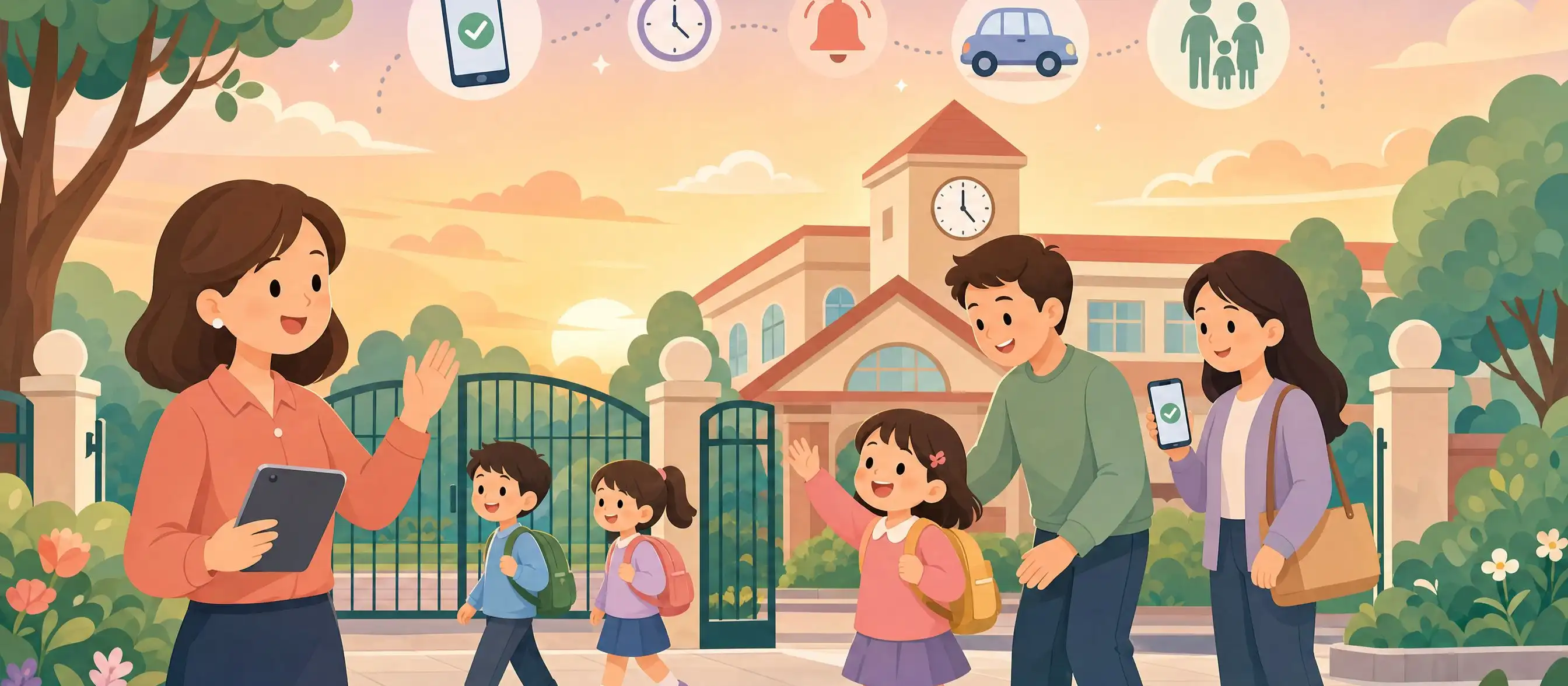
When the child is released, the guardian receives a notification on their phone with confirmation. This eliminates family anxiety, reduces calls to the front office asking for confirmation, and creates an automatic record of the release time. Systems like Kidsflow offer this functionality integrated with the authorization process.
The Complete Safe Pickup Protocol: From Start to Record
A well-organized pickup has six steps that need to work in sequence:
Family checks in digitally when leaving home — the school receives the alert in real time.
The system displays the queue and the school starts calling children in arrival order.
Guardian arrives at the gate — staff verifies identity against the photo-based authorization roster.
If authorized: immediate release with automatic record of time, identity and the staff member who confirmed.
If not authorized: verification protocol — call the legal guardian before any release.
Family receives a push notification confirming the child has been released — full record generated.
This complete protocol is exactly what Kidsflow automates: every step — from check-in to notification — happens in an integrated way on the platform, no paper, no WhatsApp, with an auditable record of every event.
How to Organize Drop-off: Specific Considerations
Drop-off deserves specific attention because it's the moment when the school takes custody of the child — and that handoff also needs to be documented and safe.
Integrated attendance recording
Modern school management systems allow automatic attendance recording at drop-off — by QR code, turnstile or app confirmation. This eliminates manual roll call in the classroom, frees up pedagogical time, and lets parents confirm that their child has arrived at school.
Late arrival communication
The school needs a clear protocol for students arriving late: how they enter, who receives them, how attendance is recorded and how the family is notified. Recurring late arrivals need to be monitored — both for the student's well-being and for attendance compliance.
Visitor access control
Parents, guardians and visitors entering the school during class hours need a specific flow: identification, registration and escort to the meeting point. Allowing anyone into pedagogical areas without control is a real safety risk and a source of classroom disruption.
Frequently Asked Questions (FAQ)
How do you organize pickup at a school with many classes?
The most effective strategy is segment-based staggering combined with digital check-in. Each segment gets a 10–15 minute pickup window, and families check in through the app when leaving home — letting the school prepare the children in advance. With digital check-in, dismissing 300 students that today takes 40 minutes can be done in under 15.
Which app is best for organizing student pickup?
Kidsflow is the most complete platform built specifically for pickup management: it combines digital check-in, real-time queue dashboard, photo-based authorization control, temporary QR codes for occasional pickup people, push notifications and auditable records — all in a platform built with exclusive focus on this problem.
How do you control who can pick up the students?
The safest solution is a digital roster of authorized people with verified photos, kept up to date by guardians through the app. For one-off authorizations (grandma picking up today only), the system should generate a QR code with a date and time validity — eliminating WhatsApp as an authorization channel, which lacks verified photos and legal validity.
How long should pickup last in a well-organized school?
In schools with digital pickup management and family check-in, average wait time drops to 5–10 minutes per student — and total peak congestion lasts less than 15 minutes. Schools without digital management typically have 30–40 minute congestion peaks, with families waiting in car lines.
How do you organize pickup for early childhood students?
In early childhood, authorization control is critical: the child is 2–6 years old and cannot identify or question who is coming for them. The process needs: a roster of authorized people with photos (not just names), mandatory visual verification at the gate, a formal channel for one-off authorizations, and a record of every release. Kidsflow was developed with special focus on early childhood, where this problem is most critical.
How do you avoid car lines in front of the school?
Three combined changes eliminate the line: (1) staggered dismissal by class — don't release everyone at once; (2) digital family check-in — the school knows who's arriving and prepares the child in advance; (3) early calling — by the time the car arrives, the child is already at the gate. This combination cuts each vehicle's time at the curb from minutes to seconds.
Can the school be held liable if a student isn't picked up on time?
Yes. The school maintains custody of the student until they are handed over to a guardian. If the guardian doesn't show up and the school doesn't have a documented protocol for that situation — who to contact, in what order, after how much time — the institution is legally exposed. The protocol needs to be written, communicated to families and trained with the team.