Kidsflow vs. WhatsApp: Why Parent Groups Are Not a Student Pickup Authorization System
· 5 min read
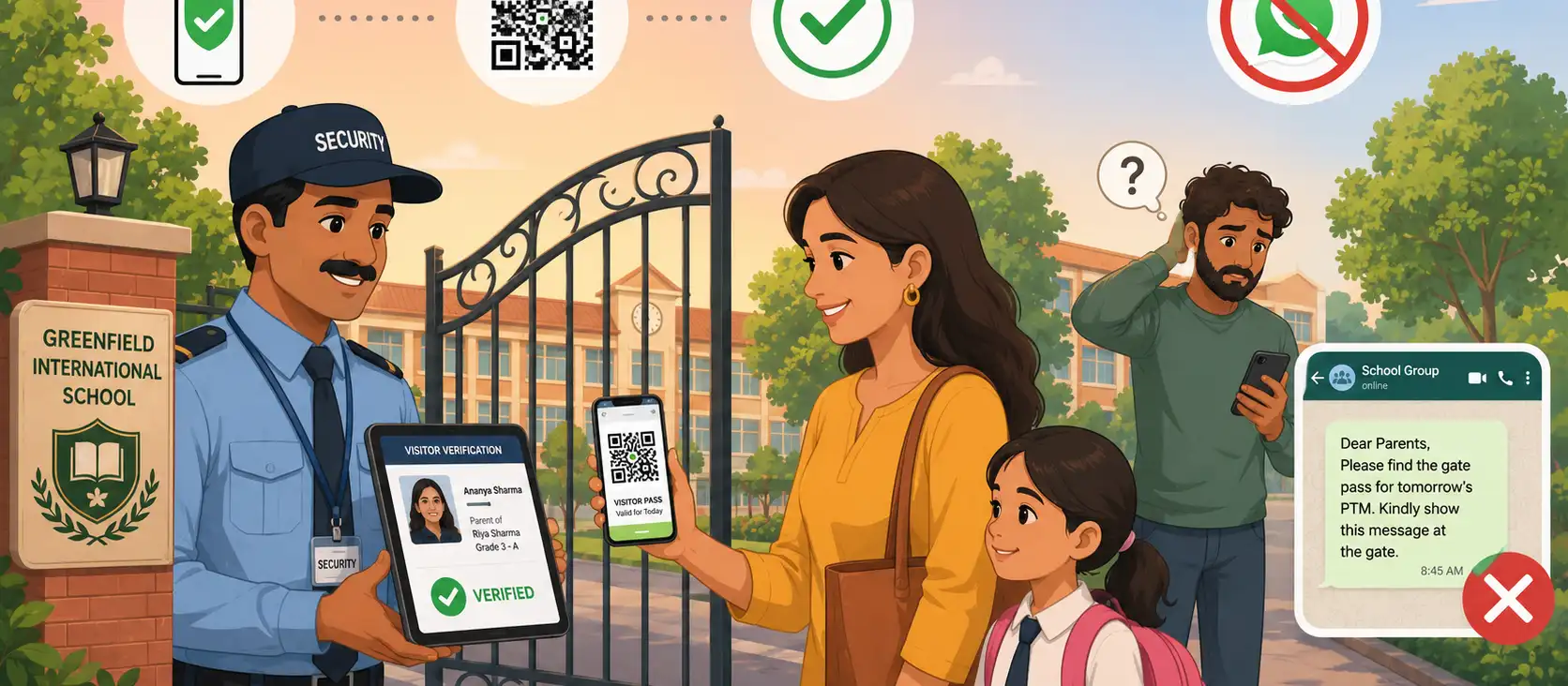
Every school that still uses WhatsApp to manage pickup authorizations has experienced some version of this scenario: a parent sends an audio message at 4:48 PM saying grandma will pick up the child, the security guard doesn't see the message, grandma arrives, the child is left waiting — or worse, leaves with someone they shouldn't have.
WhatsApp was not built for this. And using it as an authorization system is not just inefficient — it is a real legal liability for your school.
What qualifies as an "authorization system" under the law
Brazilian Civil Code Article 932 establishes objective liability for educational institutions. This means that in the event of an improper handover with harmful consequences, the school is liable — regardless of whether it acted in good faith.
This responsibility extends beyond the school gate. In specific situations — such as field trips, school transportation, or after-school programs — the school remains responsible even outside school premises.
To protect itself, the school must demonstrate that it adopted an adequate verification process. That process has minimum requirements:
Photo identification of the authorized person
Confirmation of who granted the authorization
Record with date, time, and the staff member responsible for the release
Secure data storage in compliance with Brazil's LGPD (General Data Protection Law)
WhatsApp meets none of these four requirements.
The direct comparison
Why WhatsApp seems to work — and why that's the problem
WhatsApp "works" as long as nothing goes wrong. When the guard knows all the families, when no pickup is ever disputed, and when the school has never had to defend itself in a legal proceeding, the illusion of control holds.
The problem is that failure doesn't announce itself in advance. It happens precisely when the regular guard is absent, when an unfamiliar person arrives with a plausible story, or when a parent in a custody dispute shows up at the gate outside of agreed hours.
In those moments, the question is not "what happened?" The question is: what does the school have to defend itself with?
A WhatsApp thread is not an answer.
The convenience argument — and what it ignores
The most common objection is: "But families are already on WhatsApp — it's easier for them."
That's true for the family. For the school, it's a risk transfer disguised as convenience.
Kidsflow was built to be equally simple for families — a guardian can authorize a pickup in under 30 seconds through the app, without calling the school or searching for the right group chat. The difference is that this authorization arrives at the front gate with a photo, timestamp, and full traceability.
Ease for the family does not have to mean risk for the school.
The time to switch is before the incident
Every school that has migrated to a structured authorization system did so for one of two reasons: by choice, before anything went wrong — or by necessity, after an incident that left the institution vulnerable.
The second situation is avoidable. And the cost of prevention is significantly lower than the cost of responding to a civil lawsuit.
If your school still uses WhatsApp as a pickup protocol, the time to revise that process is now — not the day after the next incident.
Want to see how Kidsflow works in practice? Schedule a demo and see in 20 minutes how your front gate can operate with security, traceability, and legal compliance — regardless of who's on duty.
Frequently asked questions
Does WhatsApp have legal validity as a student pickup authorization? No. A WhatsApp message does not constitute formal authorization with legal validity. It does not verify the identity of the person granting authorization, does not identify the authorized person with a photo, and does not generate an auditable record. In the event of a legal dispute, a WhatsApp message is rarely sufficient to demonstrate that the school followed an adequate verification protocol — which may expose it to civil liability and, in serious cases, criminal liability.
Can the school be held liable even if it acted in good faith using WhatsApp? Yes. Brazilian Civil Code Article 932 establishes objective liability for educational institutions. This means the school can be held responsible for damages resulting from an improper handover regardless of intent or good faith, if it cannot demonstrate that it adopted an adequate verification process. Good faith does not replace documented process.
Do families need to install an app to use Kidsflow? Yes, guardians use the Kidsflow app to register authorized individuals, send one-time authorizations, and track their child's pickups. The process was designed to be simple and fast — a one-time authorization takes under 30 seconds. Family adoption tends to be high precisely because the app also offers transparency and control that WhatsApp does not provide.
What happens to existing WhatsApp authorizations during the migration? When migrating to Kidsflow, the school runs an initial registration process with families — typically during the first week of implementation. Existing WhatsApp authorizations are replaced by formal photo-verified registrations in the system. Kidsflow provides support throughout this transition process.
What is the difference between Kidsflow and the front gate module in my school management system? Generic school management systems typically offer front gate modules built for the average case — basic entry and exit control. Kidsflow was developed with exclusive focus on student dismissal and authorization management, resulting in specific features such as photo verification, temporary QR codes for one-time authorizations, automatic alerts for unauthorized individuals, and an auditable record in compliance with LGPD. The depth of a specialized solution is rarely replicated by add-on modules from generalist ERPs.
Does Kidsflow work in small schools with fewer than 100 students? Yes. Kidsflow is used by schools of various sizes. In smaller schools, the primary benefit tends to be legal protection and process independence from specific individuals — especially relevant when the regular guard is the only person responsible for the front gate. In larger schools, the benefit also extends to queue management and process scalability.