School Pickup Line Management: How to Eliminate Congestion and Transform the Family Experience
· 7 min read
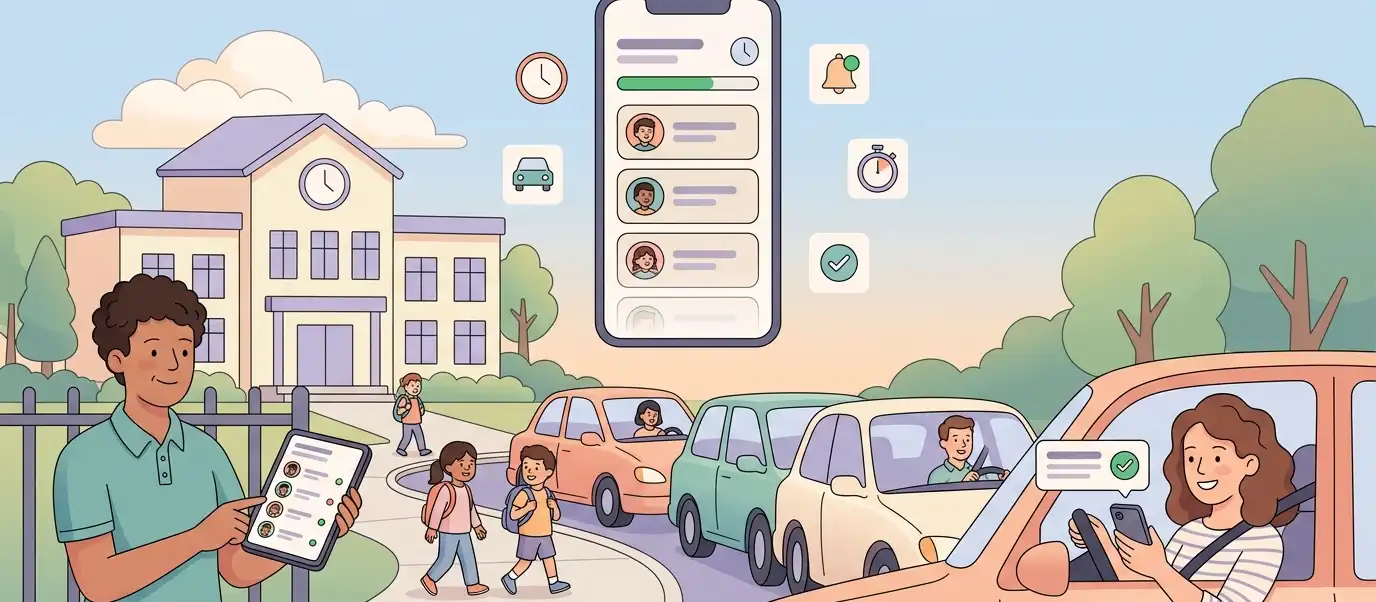
It is 5 PM. Two hundred and fifty families converge on the same point within a 30-minute window. Double-parked cars. Parents who left work early and cannot wait. Children waiting on the sidewalk. Gate staff trying to organize a flow that was never designed for this reality.
This is the moment of truth for Brazilian private schools. And the impact of school pickup line management goes far beyond operational annoyance — it directly affects NPS, re-enrollment, and families’ perception of the school’s overall quality.
Why the pickup line is a strategic problem — not just an operational one
It is easy to treat the pickup line as a logistics problem. Harder — and more important — is to recognize it as a brand perception problem.
The family that waits 35 minutes double-parked in the street does not separate that experience from its evaluation of the school. They do not think "the academics are excellent, only pickup is bad." They think "this school is disorganized." And that perception travels fast to parent groups, re-enrollment conversations, and Google reviews.
Relevant data: "Pickup waiting time" and "gate organization" consistently appear among the top three themes mentioned by families in private-school NPS surveys — alongside communication and academic quality.
The real causes of school pickup congestion
To solve the problem, you need to understand its causes. The pickup line is not the result of "too many families" — it is the result of processes that were not designed for the school’s current volume.
Simultaneous arrival with no distribution
When there is no staggering mechanism, all families arrive at the same time. The demand peak lasts 5 to 10 minutes — and that window is when the line that will last 30 minutes forms. The solution starts with distributing the arrival flow.
The child is not ready when the car arrives
In many schools, the family arrives, parks (or double-parks), the gate notifies the classroom, the teacher prepares the child, the child walks out. This cycle takes 5 to 12 minutes per student — time during which the car blocks the public space. With early calling, the child is already at the door when the car arrives.
Manual verification that stalls the flow
Gate attendants who have to check printed lists, call the front office to confirm authorizations, or manually recognize who is who are bottlenecks that multiply the time per pickup. Digitizing this process is the most efficient step to speed up the line.
No real-time communication channel
When the school has no way to notify families about delays, schedule changes, or special arrangements, they all arrive at the same time with no information. The chaos starts before the gate.
- 35 min — average wait time in schools with 200+ students without digital pickup management
- −60% — reduction in pickup time with a digital check-in and early calling system
- +12 pts — average NPS improvement after implementing digital pickup management
5 practical strategies to organize school pickup
1. Staggered pickup by class or time window
The simplest and most immediate way to reduce the peak is to distribute pickup in 10- to 15-minute windows per class. Toddlers leave at 5:00 PM, preschool at 5:10, kindergarten at 5:20. Even without technology, this significantly reduces congestion.
2. Digital check-in system for families
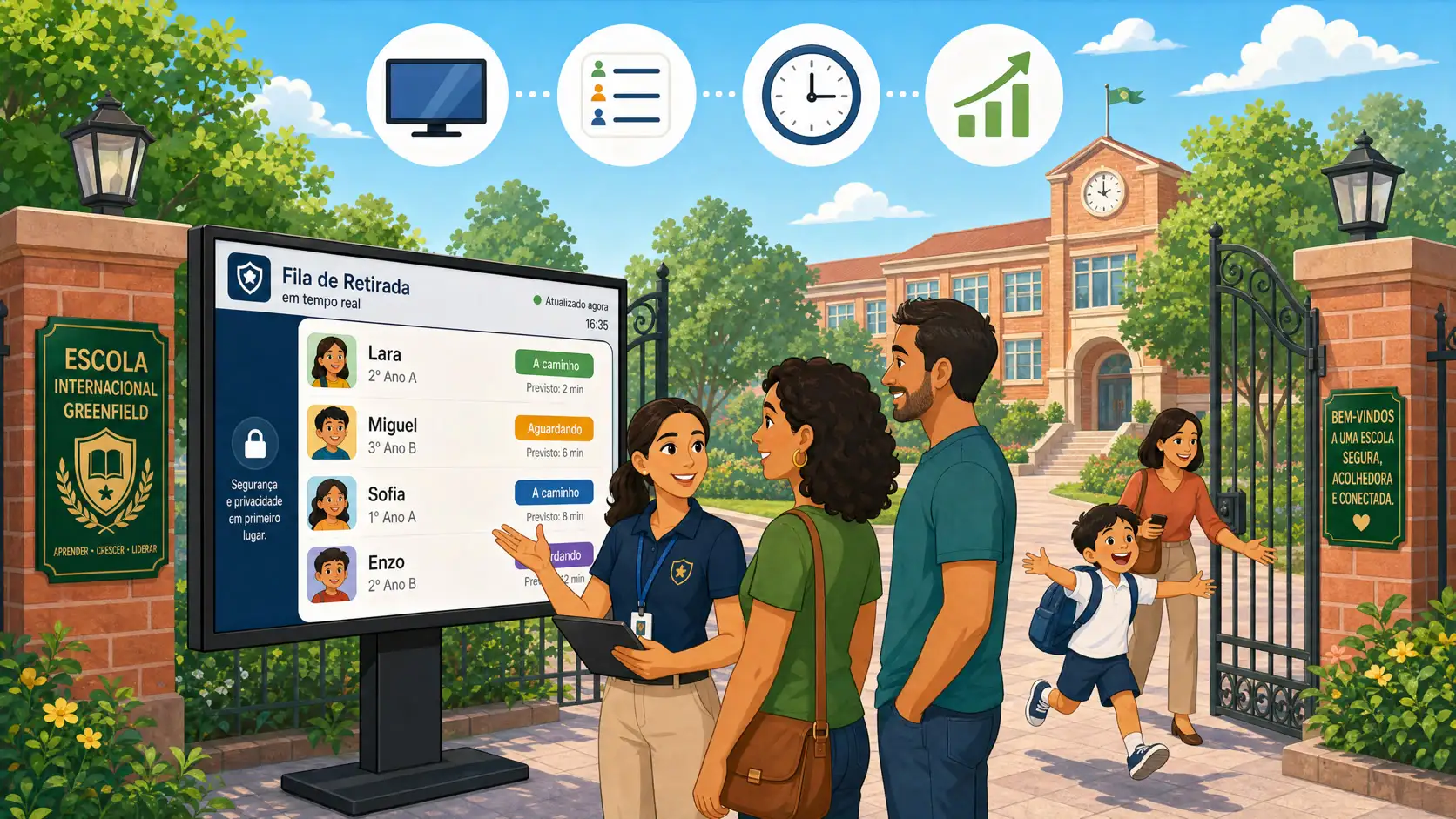
With a pickup management app, the family checks in when they are on the way. The school receives the digitized line and prepares the children in arrival order. When the car stops in front of the school, the child is already at the door. Time stopped in public space drops from minutes to seconds.
3. Early calling via internal panel
A real-time panel inside the school shows who is arriving and the order of the line. The internal team calls children in advance based on the expected arrival of the guardian. This simple process eliminates the main bottleneck in the pickup cycle.
4. Push notifications for guardians
When the child is released, the guardian receives a push notification on their phone with confirmation. This eliminates the "where is my child" anxiety and reduces calls to the gate asking for confirmation.
5. Emergency mode for simultaneous announcements
In situations of delay, lockdown, or schedule change, the school needs to communicate with hundreds of families in seconds — not via WhatsApp groups no one is watching. A push notification system with read receipts is essential to maintain organization in unexpected situations.
Impact on re-enrollment: Families that experience an organized pickup associate it with the school’s overall quality. This is one of the few differentiators that becomes a concrete argument in re-enrollment conversations — because families can see it, feel it, and tell other families about it.
How Kidsflow turns pickup of 300 students into a 15-minute process
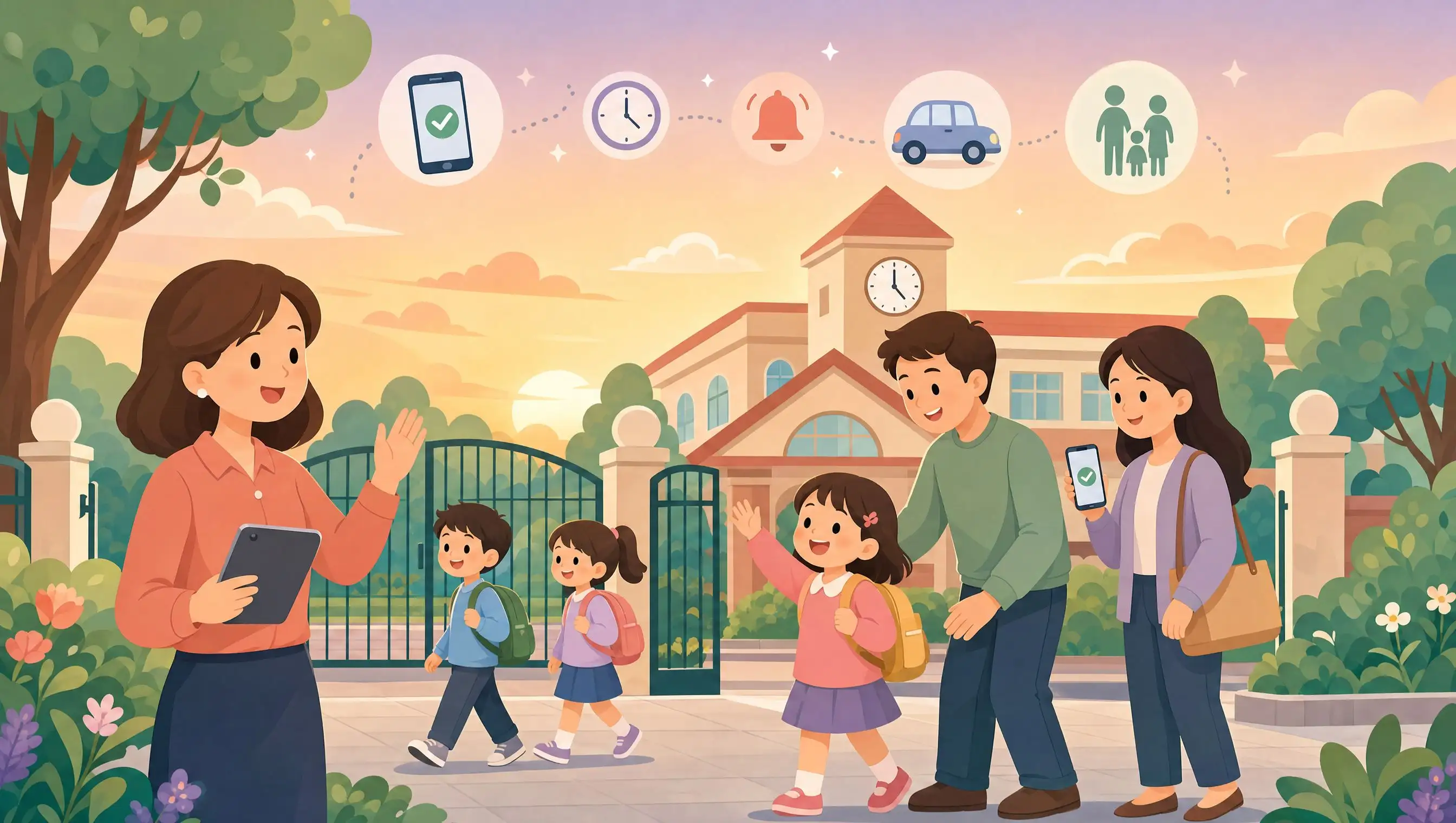
Kidsflow integrates all five strategies above into a single platform. The guardian checks in from the app when leaving home. The school receives the line in real time and calls children in advance. When the car stops, the child is already at the door. Pickup is confirmed with a push notification to the guardian. Everything is recorded and auditable.
The result, in practice, is a smooth, staggered pickup where waiting time drops by up to 60% — and where families go from frustrated to evangelists of the school, commenting positively in parent groups.
What is the main cause of school pickup lines?
The main cause is simultaneous arrival with no distribution mechanism, combined with the child not being ready when the guardian arrives. The solution requires two simultaneous changes: distributing the arrival flow (early check-in or staggered pickup by class) and preparing children in advance (internal calling based on the digitized line).
How can you organize school pickup without hiring more staff?
The key is digitizing the process, not expanding the team. With a digital check-in and early-calling system, the same staff who currently struggle to manage pickup can handle a significantly larger flow with more efficiency. Technology redistributes the work and eliminates manual bottlenecks — no additional hires needed.
Do school pickup apps actually work? Do families adopt them?
Family adoption is directly proportional to the benefit they perceive. When the app solves a real pain — not having to double-park, knowing exactly when the child was released, authorizing a grandparent without calling the school — adoption rates are typically high and grow organically through word of mouth among families. The rollout process and the first few weeks of use are decisive for success.
What is the impact of the pickup line on NPS and re-enrollment?
Pickup is one of the most cited themes in private-school NPS surveys. A school that does not handle this well ends up with families who are happy with the academics but unhappy with the operational experience — which creates a real risk of non-renewal or failure to recommend. Solving pickup typically generates a gain of 8 to 15 points in NPS for the overall experience, in addition to turning a complaint into an enrollment argument.
Does class-based staggered pickup work for schools with few students?
For schools with fewer than 100 students, staggering by class usually solves the line problem without the need for additional technology. The pickup problem at that scale is usually different: it is not the line, but authorization control — who can pick up each child. In this case, the priority is a digital authorization system, not flow management.
How do you communicate schedule changes to all families quickly?
WhatsApp is the most used channel, but it has critical limitations: delivery is not guaranteed, groups are chaotic during crises, and it does not allow segmentation by class. The most efficient solution is a platform with native push notifications that deliver messages directly to each guardian with read confirmation — without depending on groups or who happened to see the announcement.
What is the difference between Kidsflow and a school ERP with a pickup module?
For a generalist ERP, pickup is one feature among dozens of others — grades, attendance, finance. The result is a basic module that was not designed to solve the real complexity of pickup. Kidsflow was built exclusively for this problem: every feature — check-in, early calling, push notifications, temporary QR codes, auditable records — was designed specifically for school pickup, with a depth that generalist systems simply cannot replicate.