Social-Emotional Learning: What It Is, Why It Matters, and How to Implement It in Schools
· 4 min read
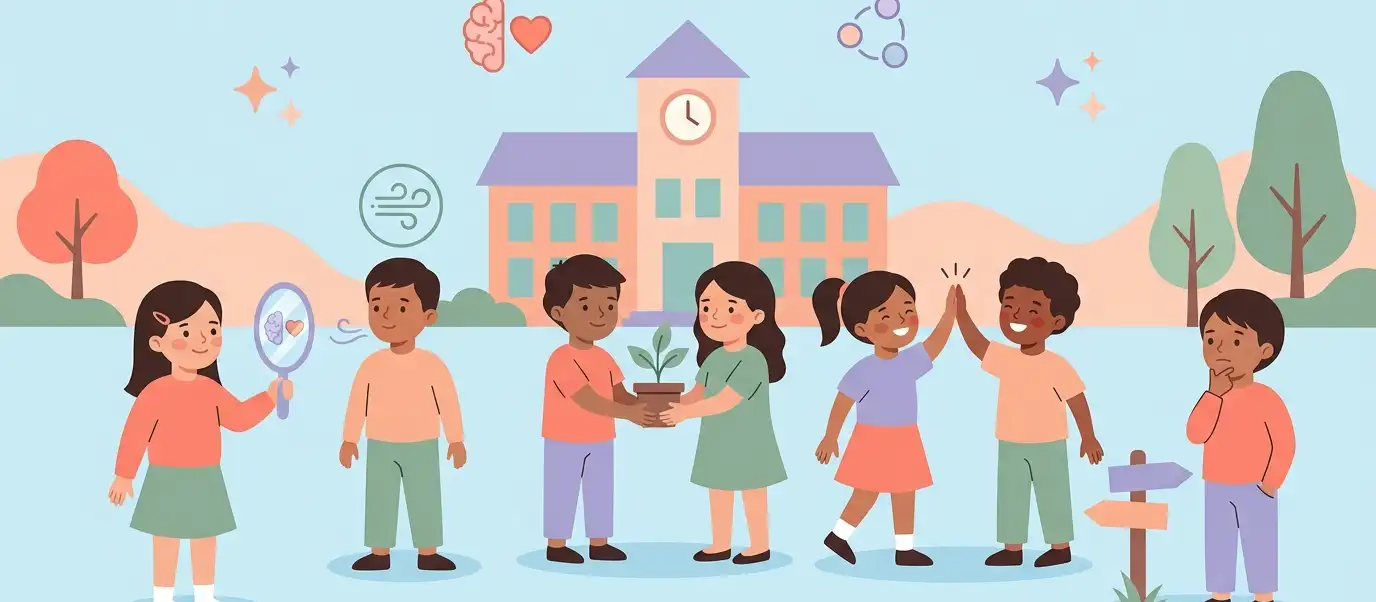
When an 8-year-old can name what they're feeling, regulate their behavior in conflict situations, and show empathy toward a sad classmate, they're exercising skills that neuroscience and psychology research identifies as predictors of academic, professional, and lifelong health success.
Social-Emotional Learning — or SEL — is the systematic process of developing these skills within the school environment. It has become an essential component of modern curricula worldwide, recognized as one of the key competencies for comprehensive education.
What Is SEL — Social-Emotional Learning
CASEL (Collaborative for Academic, Social and Emotional Learning), the world's leading reference in SEL, defines social-emotional education as the process by which children and adults effectively acquire and apply knowledge, skills, and attitudes to develop healthy identity, manage emotions, achieve personal and collective goals, feel and demonstrate empathy, and make responsible decisions.
The five core competencies of the CASEL model are: self-awareness, self-management, social awareness, relationship skills, and responsible decision-making. Each can — and should — be developed intentionally in the school environment, integrated into the curriculum rather than in isolated programs.
Scientific Basis: Why It Works
A meta-analysis published in the Journal of Child Development, with over 270,000 students in 213 SEL programs worldwide, showed that students who participated in social-emotional education programs had: 11 percentile improvement in academic results, 24% reduction in disruptive behaviors, 23% increase in social-emotional skills, and significant improvement in school climate.
Research consistently shows that students with stronger social-emotional competencies have better academic performance, lower dropout rates, and greater psychological wellbeing.
Key data: McKinsey & Company identified that 30% of jobs by 2030 will require social-emotional competencies as the primary qualification — above technical skills. Schools developing SEL are preparing students for the future workforce.
The Connection Between SEL and School Operations
Developing emotional intelligence in children requires consistency: the same skills taught in the classroom need to be practiced at every moment of the school routine — including transition moments like arrival and dismissal.
A disorganized dismissal, with prolonged waiting and uncertainty, puts the child in a state of emotional activation that contradicts what was worked on in SEL classes. On the other hand, a predictable and communicated dismissal — where the child knows they'll be called at the right moment, that the guardian is arriving, and that the process is safe — is a practical exercise in emotional regulation.
Kidsflow contributes to this environment by digitizing and organizing the dismissal flow: less waiting time, less uncertainty, more predictability. Children who leave in an organized environment arrive home in a better emotional state — which directly impacts the next day's learning. Learn more at www.kidsflow.com.br.
For schools wanting to expand the emotional connection window between family and school during the day, AlunoTV (www.alunotv.com.br) allows guardians to follow moments of the school routine live, reducing separation anxiety and strengthening trust.
How to Implement SEL in Schools: 5 Practical Steps
- 1. Map the starting point: assess which social-emotional competencies are already being developed and where the biggest gaps are
- 2. Integrate into the existing curriculum: SEL is not a separate subject — it's a lens that crosses all subjects and all routine moments
- 3. Train teachers: students' social-emotional development depends on emotionally competent and secure adults
- 4. Involve families: social-emotional skills develop in both environments — school and family need to work together
- 5. Assess and iterate: use competency assessment tools to measure progress and adjust the program
Frequently Asked Questions (FAQ)
What is social-emotional learning and what is its scientific basis?
Social-emotional learning is the intentional development of skills like self-awareness, self-management, empathy, and responsible decision-making. Its scientific basis lies in neuroscience (showing that emotions and cognition are inseparable in the learning process), developmental psychology, and decades of CASEL research demonstrating consistent improvements in academic performance and wellbeing in well-implemented SEL programs.
Is SEL part of national curricula?
In many countries, yes. Social-emotional competencies are increasingly included in national educational standards. Schools worldwide are recognizing the obligation to develop these skills as part of comprehensive education.
What is the difference between social-emotional education and school psychology?
Social-emotional education is a pedagogical process — developed by teachers, integrated into the curriculum, for all students. School psychology is a specialized service — offered by psychologists, for students with specific needs. The two are complementary, not substitutes: SEL is prevention and development; school psychology is intervention when necessary.
How long does it take for SEL program results to appear?
CASEL research indicates that well-implemented SEL programs show measurable results in 6 to 12 months, with academic gains more evident from the second year. Long-term impact — on mental health, relationships, and professional performance — manifests decades later. The investment is gradual and continuous.
How does the school environment organization impact social-emotional development?
The school's physical and operational environment is a hidden curriculum — it communicates values and expectations even without words. An organized, predictable, and safe school creates the conditions for social-emotional development. A chaotic school, where the child never knows what will happen, constantly activates the stress system and compromises both learning and emotional development.