Student Pickup Authorization Control: The Complete Guide for Safe Schools in 2026
· 8 min read
Every private school faces, every single day, one of the most critical and least discussed moments in school management: student pickup. In the 20 to 40 minutes at the end of the shift, the school must ensure that each child goes home with the right person — safely, in an organized manner, and, above all, with legal protection.
In this complete guide, we cover everything administrators, coordinators, and principals need to know about student pickup authorization control: what the law requires, the risks of manual processes, how to structure a robust protocol, and which technologies are transforming this routine in Brazilian schools.
What is student pickup authorization control?
Student pickup authorization control is the set of processes, rules, and tools a school uses to ensure that each child or teenager is only released to people previously authorized by their legal guardians.
In practice, this involves three fundamental pillars:
- Authorized-pickup registry: an up-to-date record of who is allowed to pick up each student — including fixed authorizations (parents, guardians) and one-time ones (grandparents, neighbors, drivers).
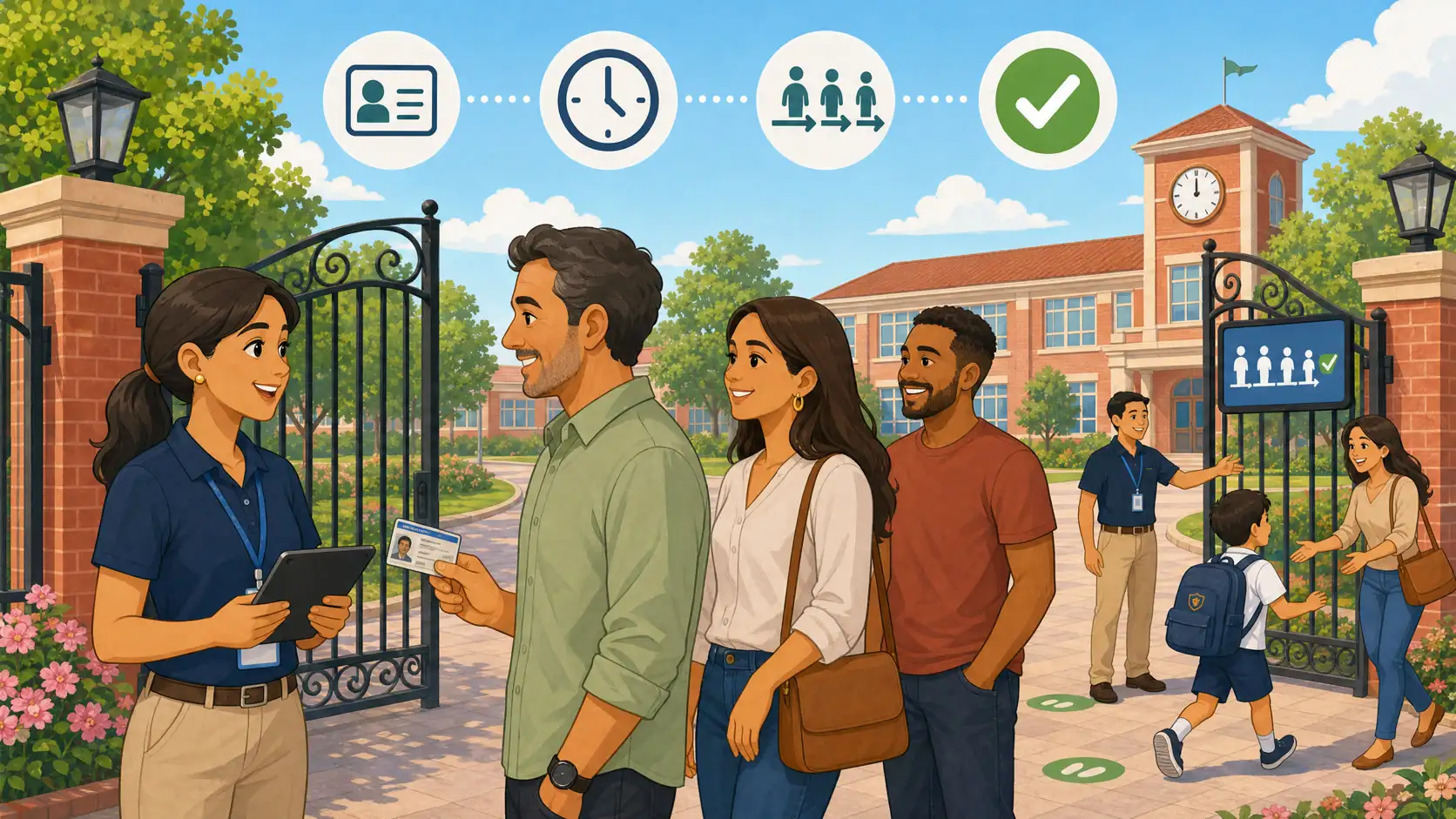
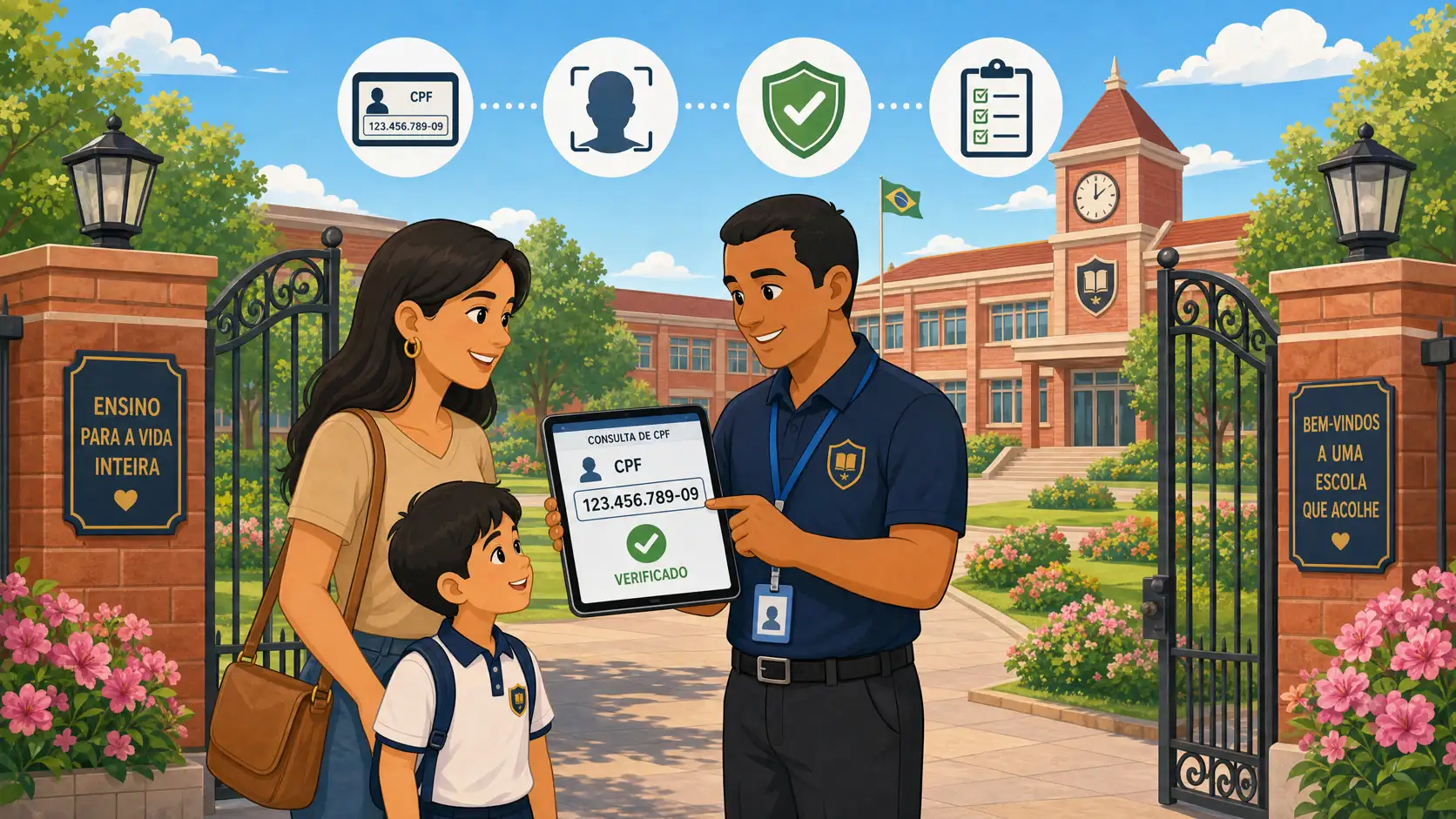
- Gate verification: the process of confirming the identity of the authorized person at the moment of pickup.
- Event record: documentation of the event — who picked up the child, when, and with confirmation of who authorized it.
Warning: The absence of a structured process is not just an operational risk — it is real legal exposure. Schools that release students without proper verification can be held civilly and criminally liable in the event of incidents.
Why the manual process fails — and when it fails
Most Brazilian schools still run pickup authorization manually: printed lists at the gate, communication via WhatsApp, and, above all, dependence on the memory of the gate attendant who "knows the families." This model has worked — until the day it stops working.
There are four scenarios in which the manual process will inevitably fail:
1. The usual gate attendant is absent
When the gate attendant who "knows everyone" is out sick, on vacation, or replaced, all of that implicit knowledge leaves with them. The substitute operates without information and without backup — turning a process that "works fine" into a real risk overnight.
2. Last-minute one-time authorizations
A mother sends a WhatsApp voice note at 4:50 PM saying grandma will be picking up her child. The gate attendant never got the message. The secretary got it but did not pass it along. The child is left waiting. This cycle repeats dozens of times a week in schools without a digital authorization process.
3. New students and families in the adjustment period
In the first months after enrollment, the gate team does not yet know the guardians. The risk of releasing a child to the wrong person is proportionally higher precisely during the period when the school most needs to demonstrate trust.
4. A guardian disputes a pickup
When a guardian disputes that their child left with an unauthorized person, what does the school have to defend itself? If the process is based on WhatsApp and human memory, the answer is: nothing legally defensible.
- 73% — of schools still use a printed list as their primary authorization control
- 1 in 5 — schools have already experienced an incident related to unauthorized pickup
- 0 — legal protection that WhatsApp offers in the event of a pickup dispute
What Brazilian law requires from schools
Brazilian law is clear about educational institutions' responsibility for the safety of students while in their care. The main legal frameworks are:
ECA — Statute of the Child and Adolescent (Law 8,069/90)
Article 17 guarantees the right to physical and psychological integrity for every child. Article 70 establishes that it is everyone's duty to prevent threats or violations of children's rights. As the guardian during school hours, the school bears direct responsibility for pickup safety.
Civil Code — Civil Liability
Article 932 establishes the strict liability of educational institutions for damages caused by their students. This means that, in the event of an improper pickup with harmful consequences, the school is held liable regardless of fault.
LGPD — Brazilian General Data Protection Law (Law 13,709/18)
Data from students and guardians — including photos, documents, and pickup records — are sensitive data under the LGPD. The school must ensure secure, encrypted storage with access control. Digital authorization systems should be evaluated for compliance with the law.
Legal best practices: Beyond operational control, schools must maintain an auditable record of every pickup, with the guardian identified, the time logged, and staff confirmation. This record is your primary line of defense in the event of future disputes.
How to structure an effective authorization control protocol
A robust pickup control protocol has four complementary layers:
Layer 1 — Authorized-pickup registry
Each student should have a registry with all guardians authorized to pick them up, including a current photo, an ID document, and the type of authorization (fixed or one-time). This registry needs to be easy for guardians to update and easy for the gate staff to consult.
Layer 2 — Verification process
At the moment of pickup, the gate team must verify the guardian’s identity against the registry — not just ask for a name. Photo verification is the bare minimum for a safe process. Additional documents may be required for specific cases.
Layer 3 — Managing one-time authorizations
For occasional authorizations (a grandmother picking up today only, a rideshare driver, a neighbor), you need a formal communication channel that: (a) records the authorization with the authorizing guardian identified, (b) reaches the gate before the authorized person arrives, and (c) includes identifying information about the person being authorized.
Layer 4 — Recording and auditing
Each pickup should generate an automatic record with: the guardian’s identity, pickup time, the staff member who authorized release, and digital confirmation. This record must be stored securely and be queryable at any time.
- Up-to-date registry of all authorized pickups with photos
- Verification process that does not rely on the gate attendant’s memory
- Formal channel for one-time authorizations with identification
- Auditable record of every pickup with date, time, and responsible staff
- Emergency protocol for cases of doubt at the gate
- Data storage compliant with the LGPD
Technology in the service of safety: how Kidsflow solves each point
Kidsflow is a platform built specifically to digitize and automate student pickup authorization control in Brazilian schools. Unlike modules inside generalist school ERPs, Kidsflow was built with an exclusive focus on this pain — which produces a depth of solution that general school management systems simply cannot replicate.
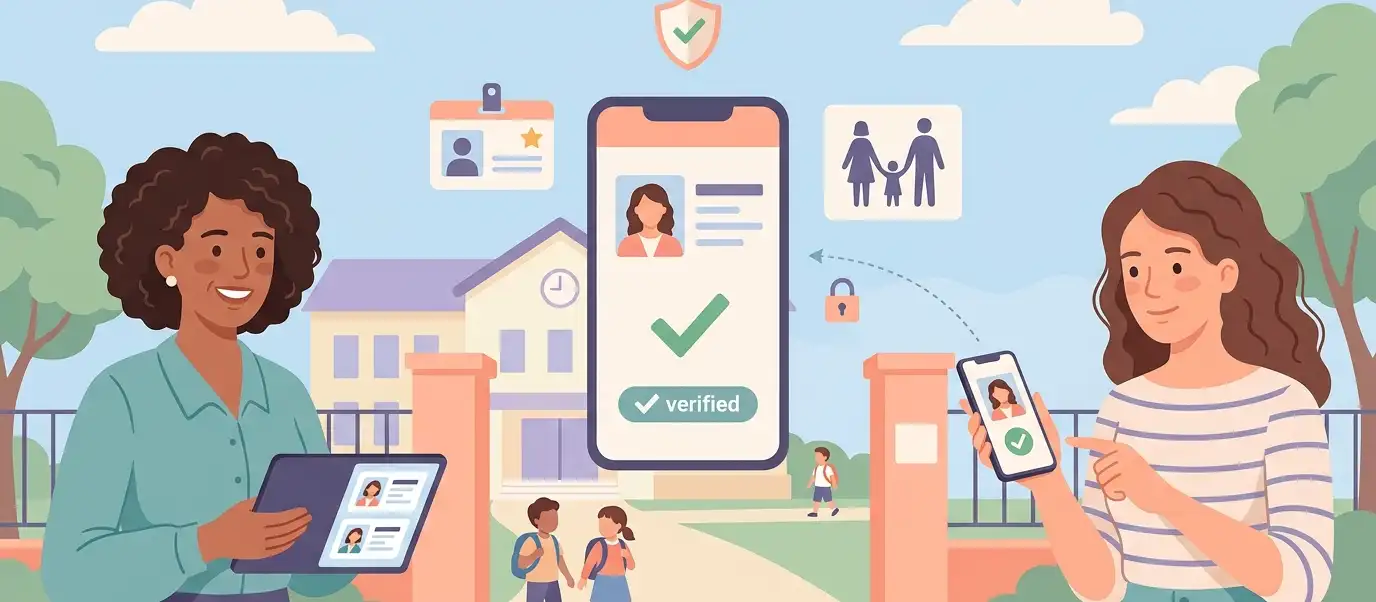
In practice, Kidsflow lets guardians register authorized pickups with verified photos directly from the app, update permissions in real time, and generate temporary QR codes for one-time authorizations — all without having to call the school. At the gate, any staff member can validate a guardian’s identity in seconds, with automatic alerts for unauthorized persons. And every pickup generates an automatic, auditable record, compliant with the LGPD.
Result: The pickup process stops depending on a specific person and starts operating in a resilient, scalable, and legally protected way — regardless of who is at the gate that day.
What is student pickup authorization and who can grant it?
A pickup authorization is the act by which a student’s legal guardian designates who is allowed to pick the child up from school. Only registered legal guardians — parents, tutors, or legally recognized guardians — can grant this authorization. It can be permanent (for regular guardians) or one-time (for occasional authorizations, with a set date and time).
Is the school liable if it releases a child to an unauthorized person?
Yes. The school is civilly and, in some cases, criminally liable for damages resulting from improper release. Article 932 of the Brazilian Civil Code establishes strict liability for educational institutions. This means the school can be held liable regardless of good-faith action, if it has not adopted adequate verification processes.
Is WhatsApp enough to authorize a student pickup?
No. A WhatsApp message has no legal standing as a formal authorization instrument. It does not verify the identity of the person authorizing, does not identify the authorized person with a photo, and generates no auditable record. In the event of a dispute, a WhatsApp message is rarely sufficient to demonstrate that the school followed an adequate verification protocol.
What is the difference between fixed and one-time authorizations?
A fixed authorization is registered permanently for regular guardians — parents and grandparents who pick up routinely. A one-time authorization is issued for specific situations, with a defined validity: a grandmother picking up today only, a driver for a specific day, a neighbor in an emergency. Both must include identification of the person being authorized. One-time authorizations require even stricter control, as they are based on last-minute communication.
How does pickup authorization control relate to the LGPD?
Data collected in the authorization process — photos, documents, pickup records — are personal data and, for children, sensitive data under the LGPD. The school must ensure a clear and legitimate purpose for processing the data, secure encrypted storage, access controlled to authorized personnel only, and a defined retention period. Digital control systems should be evaluated for LGPD compliance before adoption.
What happens when the gate attendant does not recognize the guardian arriving to pick up a child?
The school must have a clear protocol: verify the person’s identity against the authorized-pickup registry (with photo), contact the legal guardian through a secure channel to confirm authorization, and, if in doubt, do not release the child until identity is confirmed. This protocol must be documented, trained with the team, and applied consistently — regardless of time or line pressure.
Is there a specific system for student pickup authorization control in Brazil?
Yes. Kidsflow is a platform built specifically for this purpose, compliant with the LGPD. Unlike modules inside generalist school ERPs, Kidsflow offers photo verification, temporary QR codes for one-time authorizations, auditable records of each pickup, and a real-time panel for gate staff. It is used by more than 500 Brazilian schools.