School gate protocol: student drop-off and pickup step by step
· 11 min read
Between early morning drop-off and late-afternoon pickup, the school gate stops being a hallway and becomes the most critical operational moment of the day. Custody begins and ends there. Queues, rain, delays, a new babysitter, and a stressed guardian share the same square meter. A fragile protocol turns into improvisation — or a written protocol becomes real protection.
This article is operational. It is not a full legal essay on off-campus responsibility (covered in is the school responsible for students off campus) and it does not replace the flow-and-queue guide in how to organize student drop-off and pickup. The focus here is the school gate protocol: the living document that states what to do at entry, at exit, in exceptions, and in the log — with trained staff and proof of what happened.
If your team still relies on “the guard who knows every family,” use this text to turn individual memory into an auditable process. Families notice. Coordinators sleep better. And if someone later asks what the school did at that time, you have an answer.
What a real school gate protocol is
A gate protocol is not a poster on the wall or a vague paragraph in the handbook. It is a written, trained, revisable set of rules that answers four questions on any shift:
- Flow. Who enters, who exits, which path, in what order, and with which visual cues for staff.
- Authorization. Who may pick up each student, based on what, and what to do when the name is not on the roster.
- Exceptions. One-off authorization, late arrival/pickup, identity doubt, unauthorized adult, usual guard absent.
- Audit. What is logged, for how long, who can access it, and how you reconstruct an incident.
Without those four pieces, the school has habit — not protocol. Habit works while the day is calm and the same person is at the gate. It breaks on the first long holiday, the first substitute guard, or the first last-minute authorization by chat message.
Golden rule: if the procedure lives only in someone’s head, it disappears when that person is off. Written protocol + training + logging is the minimum so drop-off and pickup stay the same process Monday to Friday.
The protocol must also separate students, visitors, and vendors. Mixing all three in the same improvisation is the classic failure: a supplier “just slips in,” an uncle “only drops a backpack,” and the pickup line loses control. Each profile needs its own rule; the gate is the filter, not an improvised waiting room.
Step by step — DROP-OFF: when school custody begins
Drop-off looks lower risk because families are handing children over, not taking them away. Operationally, it is the moment the school assumes on-campus custody. If nobody records who arrived, who accompanied them, and whether the student actually entered, you start the day without a baseline — and any later dispute becomes guesswork.
1. Define the time window and access channel
Drop-off time is not only what the contract says: it is the window when the gate runs with full staff and a predictable flow. Outside that window, the late-arrival protocol must be explicit (who receives, where the student waits, who alerts coordination). Families need to know what happens if they arrive 20 minutes after the “official” gate.
2. Separate flows: students, guardians, and visitors
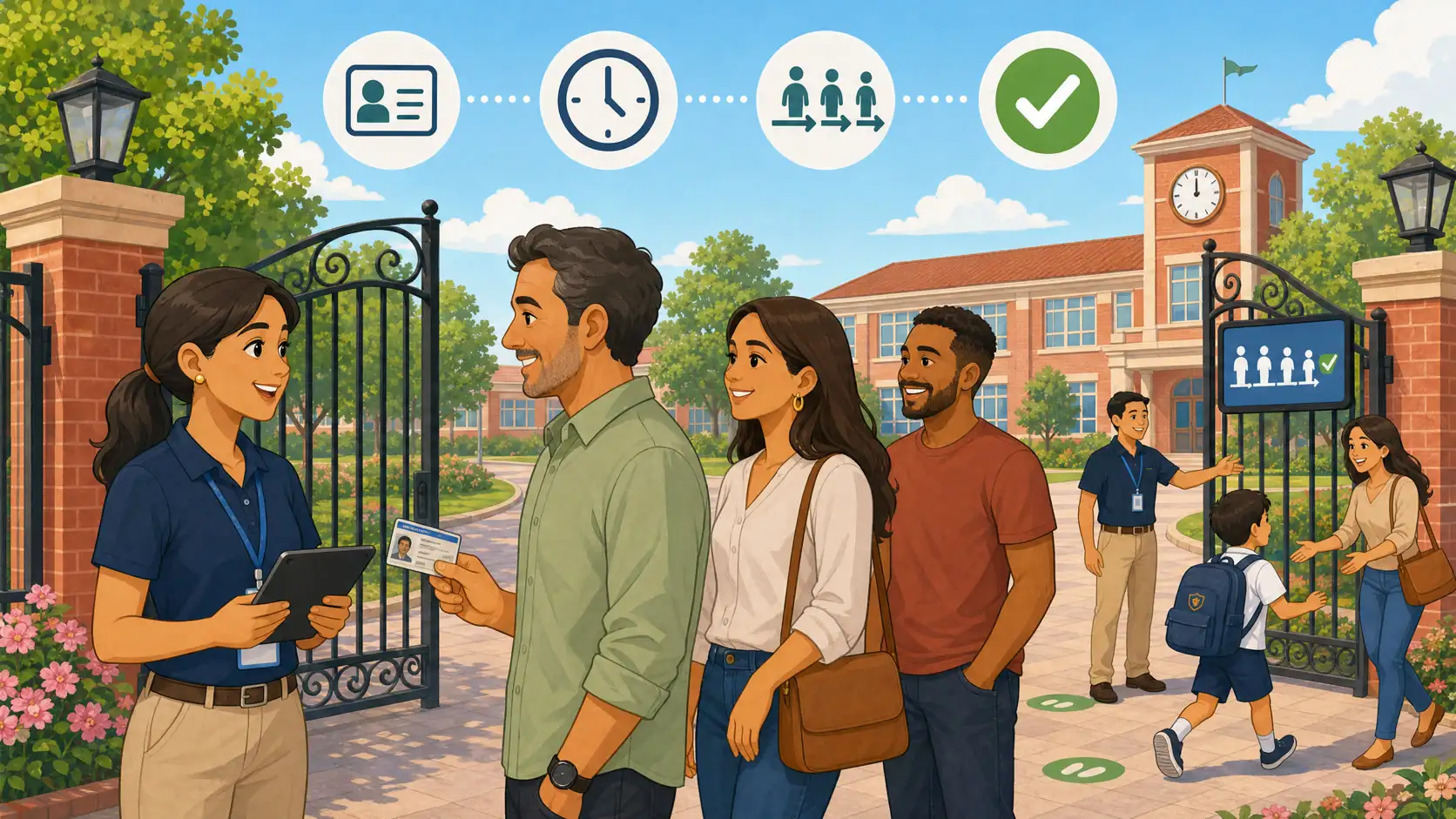
Students with a guardian at drop-off follow the defined corridor/yard path. Visitors and vendors do not “enter with the crowd” without identification. Badge, temporary credential, or visitor log — the method matters less than the rule being the same for everyone. Anyone who is not a student or an authorized pickup adult should not circulate as if they were.
3. Log the entry (even in a lean way)
Useful minimum: student identified, approximate or exact time, and confirmation that they entered under school responsibility. In daycare and early childhood, entry logging also reduces “I dropped them off and nobody saw” disputes. It does not need heavy bureaucracy; it needs to be recoverable the same day.
4. Close the gap between gate and classroom
Custody begins at the gate, but risk continues on the walk to the classroom. A good protocol defines who escorts, who counts heads, and what to do if a student “vanishes” on a 30-meter path. Pure operations: route, hallway owner, meeting point.
For the broader design of queues, signage, and staff roles, use in parallel how to organize student drop-off and pickup. The commitment here is different: drop-off belongs in the same document as pickup, with the same seriousness of logging.
Step by step — PICKUP: authorization → identity → release → log
Pickup is when mistakes are expensive. The sequence below is not cosmetics — it is the order that prevents releasing first and checking later. Reversing that order is the shortcut that creates incidents.
1. Authorization before any smile in the line
Before calling the student, staff checks who is authorized to pick up. Roster with photo, ID, and active link. One-off authorization (day babysitter, last-minute uncle) only counts if it comes through a formal, traceable channel — not a lost voice note in a group chat. Why parent WhatsApp groups are not an authorization system is covered in Kidsflow vs. WhatsApp for student pickup authorization.
2. Identity verification (not just the name)
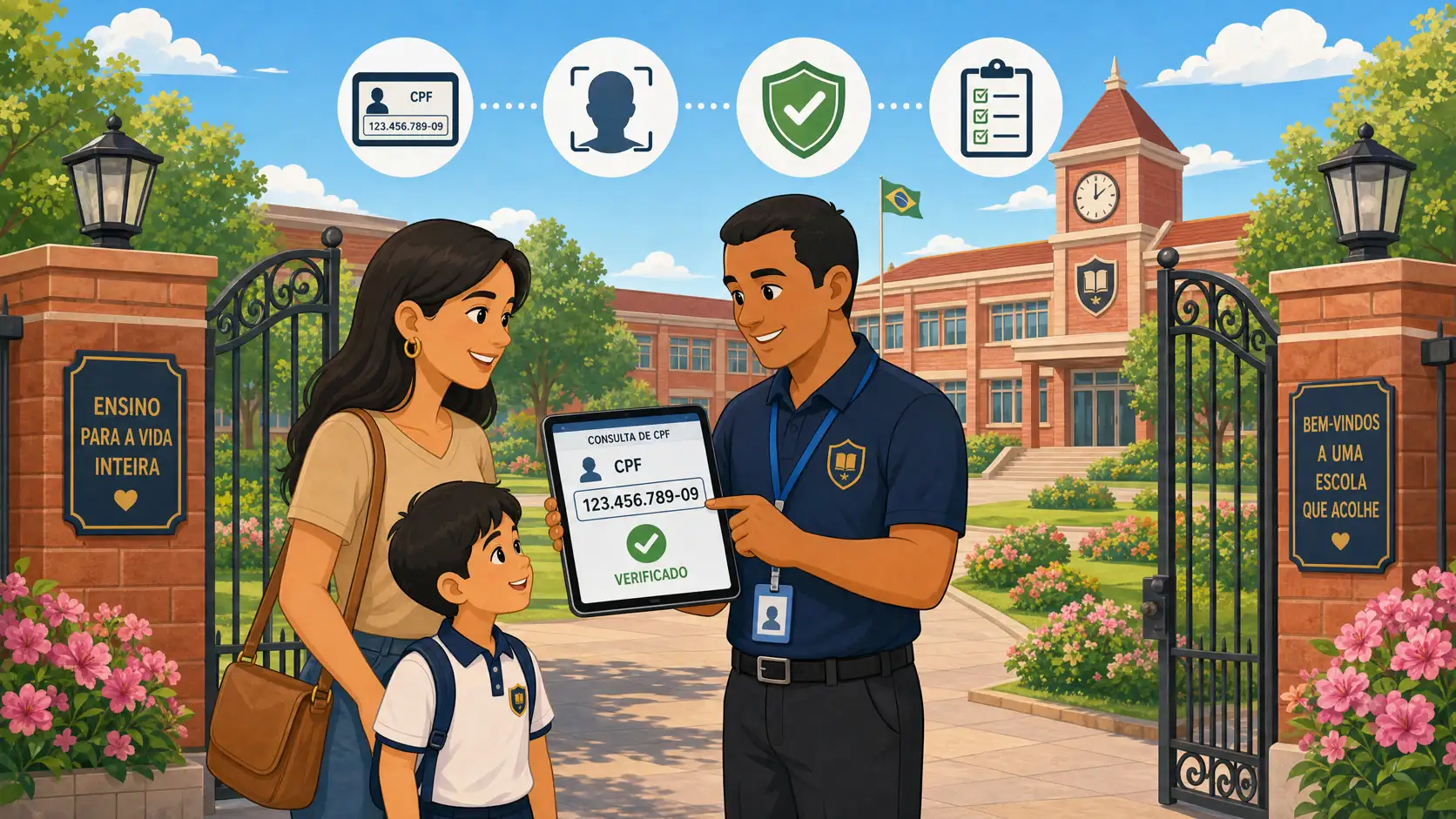
Anyone can recite the child’s full name. The protocol requires a match: person in front × photo/roster ×, when needed, ID document. “I know them by sight” may complement; it cannot be the only proof at peak hour. Doubt means pause, not haste.
3. Release only after the match
Only then is the student called and handed over. Releasing “while checking” is releasing under pressure. If the line is long, the protocol should separate the verification queue from the student waiting line — never merge them just to “move faster.”
4. Immediate pickup log
Who picked up, which student, time, staff member who released, and method (permanent roster, one-off authorization, ID at the gate, etc.). Without method in the log, you cannot reconstruct whether plan B was used with the same rigor as plan A. Full authorization control is in student pickup authorization control; the legal layer of wrongful release is in student pickup safety.
Non-negotiable order: authorization → identity check → release → log. Any shortcut that skips a step is a potential incident, not “flexibility.”
Exceptions: where the protocol proves it is real
A calm routine does not prove operational maturity. Exceptions do. Below are the cases that most often break schools without a written protocol — and what the document must spell out.
One-off authorization (last-minute change)
New babysitter, grandparent “just today,” substitute driver. Rule: formal channel, identity of the authorized person, validity (date/time), and a log entry. Without that, the gate becomes a sidewalk court. Train the standard line: “I need authorization in the school channel before release” — and back staff to use it without fear.
Late drop-off or late pickup
Late drop-off: who receives the student, where they wait until class, who alerts coordination. Late pickup: where the child waits under supervision, from which time the internal owner changes, and how the family is contacted. Leaving a student “at the gate watching the street” is not a protocol — it is exposure.
Unauthorized adult or incomplete roster
Person in line without an active link: do not release. Contact the legal guardian on a secure channel, log the decision, and only then consider release with documented one-off authorization. A verbal claim of kinship does not create authorization. Sidewalk pressure does not either.
Identity doubt
Old photo, new glasses, twin of the authorized adult, bad light. Protocol: second check (coordinator/another staff member), request for ID, or wait for confirmation. Releasing “not to embarrass anyone” is exactly the scenario the protocol exists to prevent.
Usual gate staff absent
If the process depends on one person, the school has a single point of failure. The protocol must fit the substitute: same checklist, same roster access, same exception channel. Backup training is not “when we have time” — it is a prerequisite of the document.
These exceptions should live in the same PDF/intranet as the normal flow, ideally with a one-page flowchart. At crunch time, nobody rereads a 40-page handbook.
Audit: what to log, for how long, and why it matters
Logging is not a systems vanity. It is the institutional memory of the day something was challenged. In light terms: civil liability rules for schools and child-protection duties expect processes — not good intentions. A process without a trail becomes testimony against testimony.
What to log in gate practice:
- Identity of who dropped off / picked up (or the method used to identify them).
- Student(s) involved and time.
- Staff member responsible for receipt or release.
- Authorization type (permanent, one-off, exception).
- Exception reason, when applicable (late, doubt, missing ID, etc.).
- Channel used for one-off authorization, if any.
Retention: align with counsel and privacy rules — long enough to defend the school in a typical school-year dispute, not “forever in an open spreadsheet.” Who may access, export, or delete logs must be defined. A WhatsApp screenshot in the coordination group is not an audit archive.
Audit also feeds continuous improvement: how many exception releases? How many identity doubts? Which times blow up the queue? Without data, the school debates hunches in the staff meeting. With data, it adjusts windows, staffing, and training.
Final checklist for the gate protocol
Use this list to close the document (and the training) before the next term:
- Official drop-off and pickup windows + written late rule communicated to families.
- Separated flows: students, visitors, vendors.
- Authorized-adult roster with photo and ID, updatable by the legal guardian.
- Formal channel for one-off authorization (not only messaging groups).
- Pickup order: authorization → identity → release → log.
- Playbook for identity doubt and unauthorized adults.
- Coverage plan when the usual gate person is absent.
- Minimum log fields and owner for history lookup.
- Data retention and access policy.
- In-person or simulated training with gate and coordination staff — with attendance notes.
- Quarterly protocol review (or after any incident/near miss).
If an item is missing, the protocol is still a draft. A draft at the gate is operational risk handed to every family in line.
From paper to a digital flow
A written protocol already raises the bar. Digitizing the flow — photo roster, traceable authorization, automatic pickup logs — reduces dependence on notebooks and memory. Kidsflow is built to support schools and daycares in that daily protocol: authorized adults, gate verification, and a searchable history, without turning the sidewalk into an improvised spreadsheet.
No tool replaces training and clear rules. A good tool executes the protocol the school decided. To see how it fits your operation, start at the Kidsflow site and align with coordination and counsel on what must sit in your internal document.
FAQ
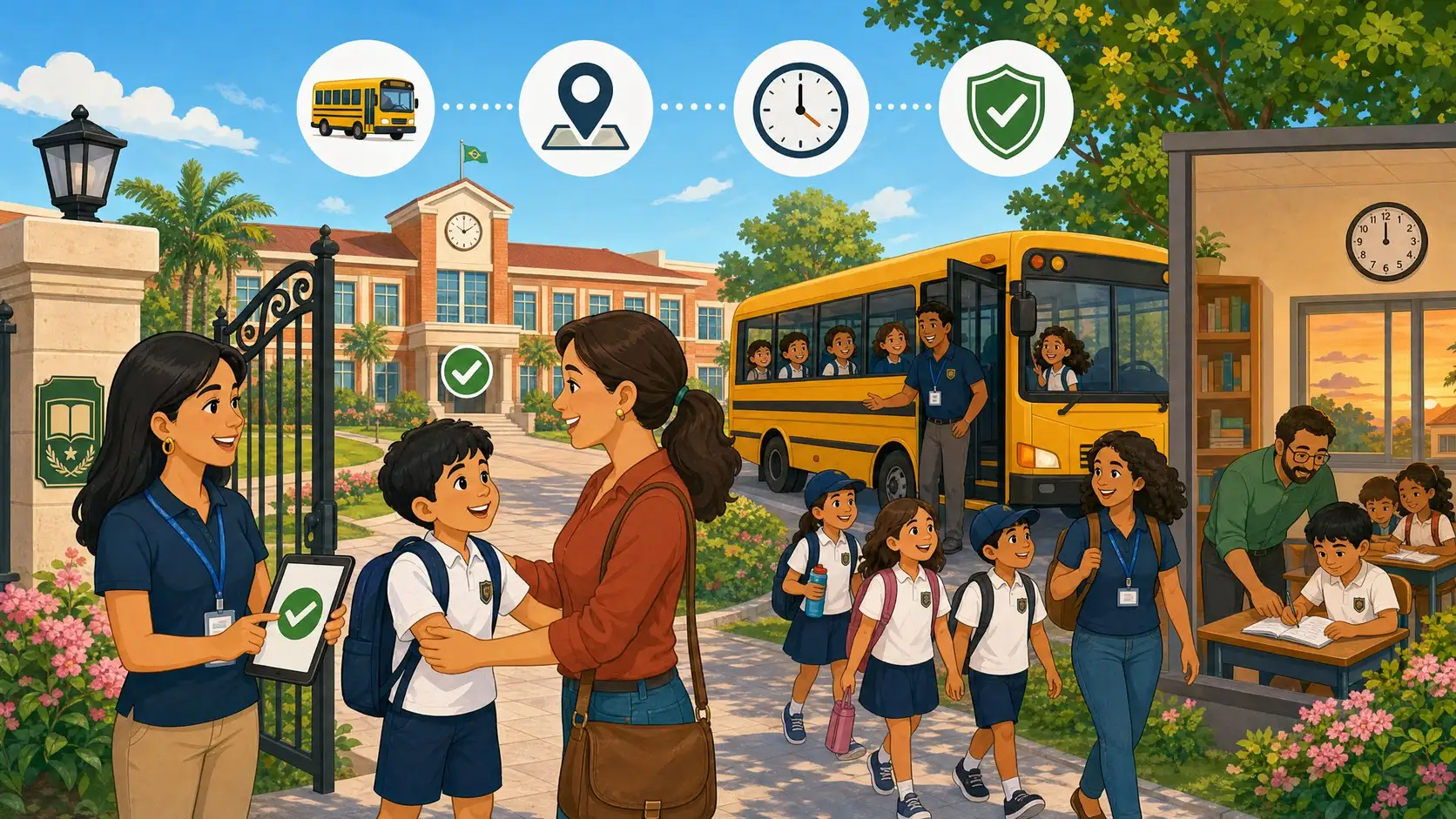
Is the school responsible for students off campus? After an authorized pickup at the gate, on-campus custody generally passes to the family; the school remains responsible in contexts such as field trips, school transport, and after-hours programs. The legal detail is in is the school responsible for students off campus.
What should school drop-off and pickup times look like in the protocol? The protocol should fix the official window, gate staffing in that interval, and the late rule (who receives, where the student waits, who communicates). Contract times without a late procedure are not a complete protocol.
What if an unauthorized person shows up to pick up a student? Do not release. Contact the legal guardian on a secure channel, log the event, and only release with documented one-off authorization. Verbal kinship does not replace the roster.
Does WhatsApp authorization count at the gate? As a sole informal channel it is weak: hard to audit, easy to challenge, and poor at peak hour. Prefer a formal channel with clear identity and validity. See Kidsflow vs. WhatsApp for student pickup authorization.
What should be logged on every student pickup? Who picked up, student, time, staff member, authorization type, and verification method. On exceptions, the reason. Without that, the school cannot reconstruct the day.
How should the gate act if the usual guard is absent? The substitute follows the same checklist and the same roster access. If only one person “knows it by heart,” the protocol failed before the absence.
Does drop-off need a protocol too, or only pickup? Both. At drop-off custody begins; at pickup it ends with verification. Treating only pickup leaves a hole at the start of the day and on the walk to class.
This text is informational for school leaders. It is not legal advice for your contract, municipality, or concrete case. Align data retention, channels, and exceptions with coordination and counsel before republishing the protocol to families.